
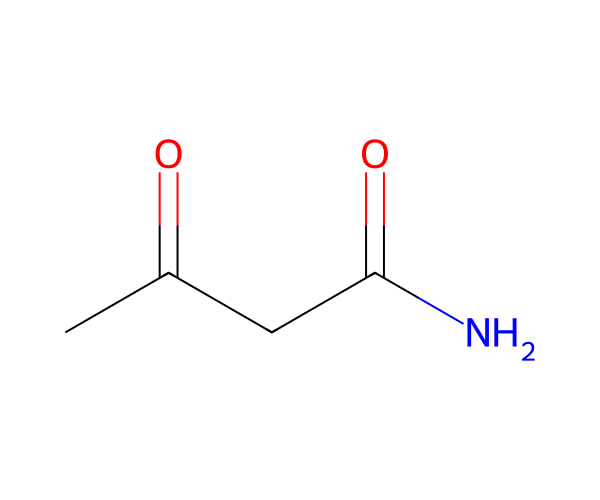
| Fórmula molecular | C4H7NO2 |
|---|---|
| Masa molar | 101.10 g/mol |
| Aspecto | White to yellowish crystalline powder |
| SMILES | CC(=O)CC(N)=O |
| InChIKey | GCPWJFKTWGFEHH-UHFFFAOYSA-N |
| Sinónimos | 3-oxobutanamide;Nsc632231;Aids134414;Aids-134414;Acetoacetamid;ACETIACETAMIDE;ACETOACETAMIDE;β-Oxobutanamide;3-Oxobutyramide;Acetylacetamide |
|---|---|
| Nombre IUPAC | 3-oxobutanamide |
| N.º CE/lista | 227-774-4 |
| Masa exacta | 101.047678 |
| Masa monoisotópica | 101.047678 |
| XLogP | -1.000000 |
| TPSA | 60.200000 Ų |
| Donantes / aceptores de enlace H | 1 / 2 |
| Enlaces rotables | 2 |
| Solubilidad | water: soluble1g/10 mL, clear, colorless |
| InChI | InChI=1S/C4H7NO2/c1-3(6)2-4(5)7/h2H2,1H3,(H2,5,7) |
| Clase de peligro | Not Classified |
|---|---|
| Indicaciones de peligro | Not Classified; Reported as not meeting GHS hazard criteria by 169 of 169 companies. For more detailed information, please visit ECHA C&L website. |
Acetoacetamide is a small β-keto amide bearing amide, ketone carbonyl and active methylene functionality. It is used as an acetoacetyl building block in condensation, N-substitution and heterocycle-forming chemistry.
Used in organic synthesis, pharmaceutical intermediates, agrochemical intermediates, and dye or pigment intermediate chemistry; also used to prepare N-substituted acetoacetamides and heterocyclic compounds.