
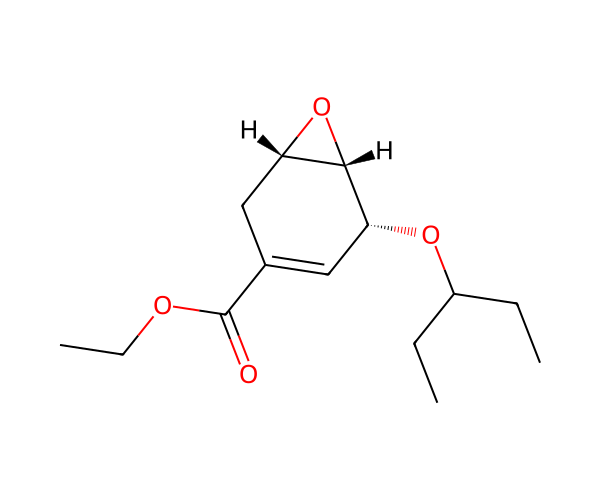
| Summenformel | C14H22O4 |
|---|---|
| Molare Masse | 254.32 g/mol |
| Aussehen | White to off-white solid |
| SMILES | CCOC(=O)C1=C[C@@H](OC(CC)CC)[C@H]2O[C@H]2C1 |
| InChIKey | XZXCGRFGEVXWIT-FRRDWIJNSA-N |
| Synonyme | ETHYL(3R,4S,5S)-4,5-EPOXY-3-(1-ETHYL-PROPOXY)-CYCLOHEX-1-ENE-1-CARBOXYLATE;Oseltamivir epoxide;Ethyl (1S,5R,6S)-5-(pentan-3-yl-oxy)-7-oxa-bicyclo[4.1.0]hept-3-ene-3-carboxylate;[1s-(1a,5b,6a)]-5-(1-ethylpropoxy)-7-oxabicyclo[4.1.0]hept-3-ene-3-carboxylic acid ethyl ester;ETHYL(3R,4S,5S)-4,5-EPOXY-3-(1-ETHYL-PROPOXY)-CYCLOHEX-1-ENE-1-CARBOXYLATE(INTERMEDIATE OF OSELTAMIVIR PHOSPHATE );(1S,5R,6S);EEC epoxide;Oseltamivir Impurity463;Oseltamivir intermediate;Oseltamivir intermediates |
|---|---|
| IUPAC-Name | ethyl (1S,5R,6S)-5-pentan-3-yloxy-7-oxabicyclo[4.1.0]hept-3-ene-3-carboxylate |
| EC-/Listennummer | 429-020-1 |
| Exakte Masse | 254.151809 |
| Monoisotopische Masse | 254.151809 |
| XLogP | 2.400000 |
| TPSA | 48.100000 Ų |
| H-Brücken-Donoren / Akzeptoren | 0 / 4 |
| Drehbare Bindungen | 7 |
| Löslichkeit | Chloroform (Slightly), Methanol (Slightly) |
| InChI | InChI=1S/C14H22O4/c1-4-10(5-2)17-11-7-9(14(15)16-6-3)8-12-13(11)18-12/h7,10-13H,4-6,8H2,1-3H3/t11-,12+,13-/m1/s1 |
| Gefahrenklasse | GHS07 Warning (refer to SDS) |
|---|---|
| Gefahrenhinweise (H-Sätze) | H317: May cause an allergic skin reaction [Warning Sensitization, Skin]; H373 **: May causes damage to organs through prolonged or repeated exposure [Warning Specific target organ toxicity, repeated exposure] |
A chiral epoxy ethyl carboxylate intermediate associated with oseltamivir synthesis, featuring a 7-oxabicyclo[4.1.0]heptene scaffold, epoxide motif, and ethyl ester functionality.
Primarily used as a pharmaceutical intermediate for oseltamivir/oseltamivir phosphate related synthesis, research, and process development.