
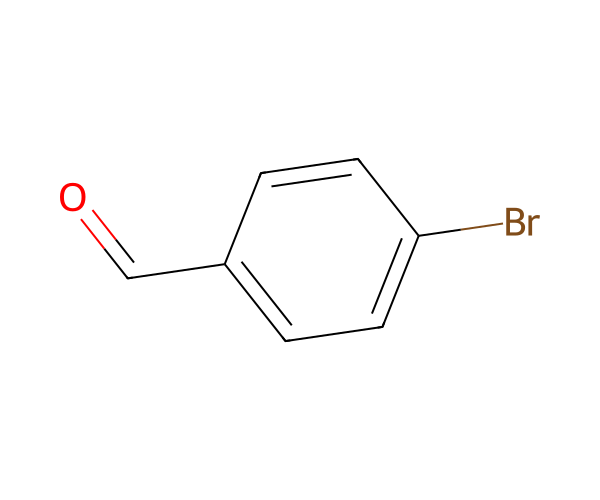
Bromobenzaldehyde;4-BBA;4-Brombenzaldehyd;4-bromo-benzaldehyd;P-BROMOBENZALDEHYDE;4-BROMOBENZYLALDEHYDE;4-Bromobenzaldehyde99%;BRBA1;DK484;4-BromobenzaL
| Numéro CAS | 1122-91-4 |
|---|---|
| N° CE / liste | 214-404-6 |
| Formule moléculaire | C7H5BrO |
| Masse molaire | 185.02 g/mol |
| Nom IUPAC | 4-bromobenzaldehyde |
| Masse exacte | 183.952380 |
| Masse monoisotopique | 183.952380 |
| XLogP | 2.200000 |
| TPSA | 17.100000 Ų |
| Donneurs / accepteurs de liaison H | 0 / 1 |
| Liaisons rotatives | 1 |
| Aspect | White to light yellow crystalline solid |
| Solubilité | Chloroform, Ethyl Acetate |
| SMILES | O=Cc1ccc(Br)cc1 |
| InChIKey | ZRYZBQLXDKPBDU-UHFFFAOYSA-N |
| InChI | InChI=1S/C7H5BrO/c8-7-3-1-6(5-9)2-4-7/h1-5H |
| Description | 4-Bromobenzaldehyde, a bifunctional aromatic with para-bromo and aldehyde. The aldehyde undergoes condensation, oxidation, and reductive amination; the bromide is a classic substrate for Pd-catalyzed Suzuki, Stille, and Buchwald-Hartwig couplings. Key intermediate for biphenyls, diarylamines, and polysubstituted arenes. |
| Applications | OLED intermediate; pharmaceutical intermediate; Suzuki coupling substrate; aldehyde building block |
| Classe de danger | Acute Tox. 4 (Oral); Skin Irrit. 2; Skin Sens. 1; Eye Irrit. 2 |